
Batman and Robin Discover the Missing Show (film #32 in the 1966 ABC Fall Preview section of TVParty). [Category: Commercial]
Campy, silly ending to the 1966 ABC fall preview show, in which Batman and Robin discover Milton Berle under the desk and sentence him to a series run of five years. It ends with some very 60s-style groovy animation. A real blast from the 60s.Ratings: Camp/Humor Value: ****. Weirdness: ****. Historical Interest: *****. Overall Rating: ****.
The Adventures of Gadi Ben Sussi (film #8 in the Pre-State section of Stephen Spielberg Jewish Film Archive). [Category: Sleaze & Outsider]
Primitive silent cartoon from the early 30s showing the adventures of a Yemenite character in Tel-Aviv, with subtitles in Hebrew. Frankly, I couldn’t make head nor tails of this one, though it was rather fun to look at, what with its tooney animation and body parts flying everywhere.Ratings: Camp/Humor Value: ***. Weirdness: ****. Historical Interest: ****. Overall Rating: ***.
Channah Means Grace (film #3 in the Health section of the State of Israel section of Stephen Spielberg Jewish Film Archive). [Category: Public Service]
This touching film from the early 50s profiles Channah, a girl who cannot walk due to injuries she suffered in a DP camp, and how she is helped by professionals at the Hadassah Medical Center to walk again. Surgery and physical therapy result in her legs returning to normal, yet Channah will not try to walk without assistance. A psychological evaluation reveals that Channah’s traumatic experiences make it hard for her to trust, so the treatment team makes the wise decision to build Channah’s desire for rehabilitation by having her take dance classes, something she has shown interest in. Eventually, she learns to walk by learning to dance. This is a very well-made film that shows an unusual degree of understanding of its troubled protagonist and of the importance of psychological factors in physical rehabilitation. It is one of the better examples of a public service film; one that manages to stimulate empathy in the viewer for the struggles of the people it portrays.Ratings: Camp/Humor Value: N/A. Weirdness: ***. Historical Interest: *****. Overall Rating: *****.

Air Head Videos 2 (film #303 on Open Source Movies). [Category: Outtakes & Obscurities]
More Stupid Lego Tricks. The giant baseball is pretty cool, though, as well as the metamorphosis scene.Ratings: Camp/Humor Value: ***. Weirdness: ***. Historical Interest: ****. Overall Rating: ***.

Collision of the Andrea Doria and the Stockholm (film #47 in the Featured Clip Archive section of WPA Film Library). [Category: News]
Fairly exciting newsreel story about the early-60s shipwreck of the Andrea Doria after she collided in the fog with the Stockholm. This has lots of historical value, as well as striking footage of a ship sinking below the waves.Ratings: Camp/Humor Value: N/A. Weirdness: ***. Historical Interest: *****. Overall Rating: ****.
And on the Seventh Day (film #8 in the Cities section of the State of Israel section of Stephen Spielberg Jewish Film Archive). [Category: Military & Propaganda]
Residents of Jerusalem flash back to painful experiences from the Six-Day War in this 60s film. Unfortunately, it’s in French, so I couldn’t understand the narration, but even given the language barrier, the film has impact. This is one I really wish the archive had provided English subtitles for.Ratings: Camp/Humor Value: N/A. Weirdness: ***. Historical Interest: *****. Overall Rating: ****.
Felix the Cat Swtiches Witches (film #7 on Felix the Cat, Vol. 1 (Video Resources, 1994)). [Category: Hollywood]
It's Halloween night, and Felix goes around pulling pranks. Just when you're wondering why he is fooling around with a lame old jack-o-lantern instead of manipulating reality, he starts switching the front and back ends of various animals and inanimate objects. Now that's a prank! The cartoon ends with Felix getting his fortune told and being chased by a witch, which is not nearly as much fun as the pranks, but still, this is a great cartoon.Ratings: Camp/Humor Value: ****. Weirdness: *****. Historical Interest: ****. Overall Rating: ****.

Desert Venture (in the Ephemeral section of Open Video Project. Also, film #420 on Prelinger Archive). [Category: Industrial]
This 40s film, made by Standard Oil of California, documents the initial search for oil in Saudi Arabia, and how its discovery was so beneficial for Americans, Arabs, starving war victims in Europe, and, oh, everybody all over the world. The film itself is fairly straightforward and unsurprising, but the ironic baggage it carries in light of future events is humongous. Perhaps the most ironic moment is a map that turns arrows pointing from North and South America to Europe, indicating the flow of oil, to a huge arrow going from the middle east to Europe. Point that arrow everywhere and you pretty much have today’s oil situation. Beyond that, there are some mildly fun scenes of the totally unassimilated American community in Saudi Arabia, complete with housewives buying convenience foods in supermarkets; and lots of scenes of sand, oil drilling, camels, and Arabs.Ratings: Camp/Humor Value: ***. Weirdness: ****. Historical Interest: *****. Overall Rating: ****.
Alice Gets in Dutch (film #3 on Disc 1 of Disney Rarities DVD (Disney, 2005)). [Category: Hollywood]
Alice gets in trouble at school for participating in a prank involving a balloon and a bottle of ink, and so has to sit in the corner with a dunce cap on her head. There she falls asleep and has a dream about jamming with some barnyard animals. The jam session is interrupted by the Evil Cartoon Teacher and her evil anthropomorphic textbooks and the inevitable war ensues. Superior firepower is ultimately overcome by creativity and a junk pile. This cartoon is a great deal of fun, featuring delightful characters, excellent acting by the girl playing Alice, and wonderful soundtrack music that enhances the action on screen. Kudos to Disney for digging these “Alice” toons up and restoring them so well. For 20s toons, they hold up remarkably well today.Ratings: Camp/Humor Value: ****. Weirdness: *****. Historical Interest: *****. Overall Rating: *****.
Children of Japan (in the Ephemeral section of Open Video Project. Also, film #314 on Prelinger Archive). [Category: Educational]
Considering the year this was made, 1941, I at first thought it was a WWII propaganda film. But no, this is a charming children’s educational film made just before the war about life in Japan. We follow two siblings, Taro and Yukiko, as they go through their day with their family, at school, and going to a cherry blossom festival. It looks pretty realistic, though in simplified form, about Japanese life at the time, and everything seems peaceful and well-ordered. Look at all those strange but nice people from another culture, children! Don’t be afraid––they may seem different to us, but deep down they’re really like you and me. How quickly that would change! In fact, I wonder if this film got any showing in classrooms at all, considering how quickly its tolerant message became outdated. I could swear I saw the scene of Japanese boys practicing fencing at school in a later propaganda film. Here, it’s shown as another charming Japanese cultural practice, but in the other film it was shown as proof of Japanese indoctrination of children in military values. Overall, this is an interesting snapshot of our attitudes towards the Japanese just before we went to war with them.Ratings: Camp/Humor Value: *** (gets an extra star for the fact that it just begs for msting about Godzilla). Weirdness: ***. Historical Interest: *****. Overall Rating: ***.
Beulah (film #6 in The Beulah Show section of TVParty). [Category: Early Film & TV]
This clip from the early 50s sitcom “Beulah” features Oriole, Beulah’s vapid neighbor, in a stereotyped performance that is painful to watch today. Let this serve as a reminder of what we don’t want to go back to.Ratings: Camp/Humor Value: ****. Weirdness: ****. Historical Interest: *****. Overall Rating: ****.
Batman (film #13 in the 1966 ABC Fall Preview section of TVParty). [Category: Commercial]
Campy, brief clip from the 1966 ABC fall preview show featuring Batman and Robin doing their schtick. Lots of fun if you like your Batman campy.Ratings: Camp/Humor Value: ****. Weirdness: ****. Historical Interest: ****. Overall Rating: ****.
Adullam (film #10 in the Rural Settlement and Security section of the State of Israel section of Stephen Spielberg Jewish Film Archive). [Category: Sleaze & Outsider]
Short 50s film in Hebrew documenting the settlement and development of Adullam, one of Israel’s frontier areas. This is pretty straightforward footage of surveying, building, and planting, and though I can’t understand Hebrew, I somehow suspect the narration contains few surprises. Some cool-looking model buildings provide a few moments of interest in the middle of the film, though.Ratings: Camp/Humor Value: *. Weirdness: *. Historical Interest: ***. Overall Rating: **.
The Big Moment (film #10 in the Jewish Communities section of Stephen Spielberg Jewish Film Archive. Also, film #12 in the Rural Settlement and Security section of the State of Israel section of Stephen Spielberg Jewish Film Archive). [Category: Public Service]
This 50s film uses Hollywood stars and filmmaking techniques to solicit contributions for the United Jewish Appeal. Robert Young narrates three stories about fictional displaced Jewish people who are helped by agencies funded by the United Jewish Appeal. The stories are fairly touching, though in a Hollywood way. Somehow Donna Reed fails to be convincing as a displaced Jewish woman on an Israeli settlement. I’m not sure, though, whether a more documentary approach would have been more effective, as the Hollywood approach certainly has emotional appeal. The film is an interesting historical record of how charitable funds were solicited during the 50s, as well as being an interesting anomaly from a time when anti-Semitism was acceptable, though nice people didn’t talk about it much.Ratings: Camp/Humor Value: ***. Weirdness: ****. Historical Interest: *****. Overall Rating: ****.
Air Head Videos (film #302 on Open Source Movies). [Category: Outtakes & Obscurities]
Look, Ma! I can make my Lego guys do tricks! And to disco music! That’s basically the point of this brief brickfilm, which means there’s not much point to it, but it’s lively.Ratings: Camp/Humor Value: ***. Weirdness: ***. Historical Interest: ****. Overall Rating: ***.
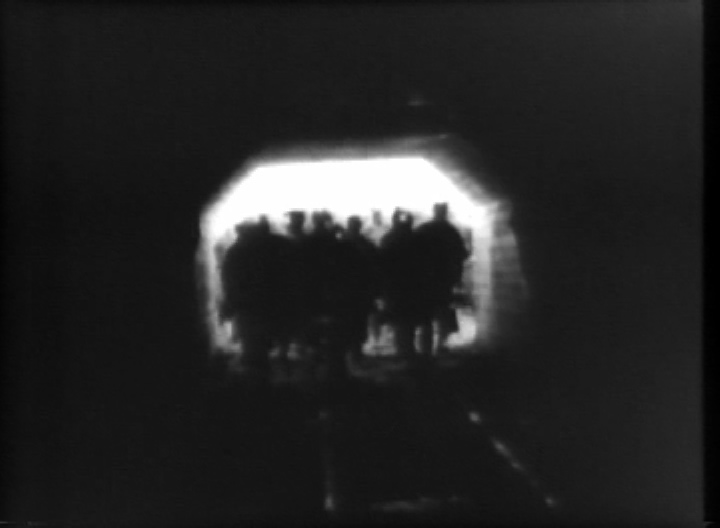
Coal Strike Ended (film #132 on Universal Newsreels). [Category: News]
40s newsreel reporting the end of a coal strike. Everybody is happy and cheerful, but you just know this is a temporary lull in a long struggle between labor and management. Some striking scenes of miners going underground are included. This is followed by a story about Catholic charities sending food to starving people overseas, including some interesting footage of food packing and shipping. This is one to mine for a video project.Ratings: Camp/Humor Value: **. Weirdness: ***. Historical Interest: ****. Overall Rating: ***.
Adventure in Freedom (film #8 in the Holocaust section of Stephen Spielberg Jewish Film Archive). [Category: Military & Propaganda]
This 50s film documents a Norwegian rehabilitation program for “hardcore DPs,”: holocaust survivors who could not rebuild their lives because of old age, disease, or disability, and thus were left to a depressing existence in displaced-person camps, a final insult to those who had already suffered so much. The Norwegian program chose some of the more promising of these people and gave them various forms of rehabilitation that helped them become eligible for resettlement and employment. This is an inspiring story, but the fact that only a small portion of the DP population could be helped this way lends a rather depressing note to things. Most holocaust stories end at the end of the war; this film provides a historically important look at the long-term aftereffects of it for many survivors.Ratings: Camp/Humor Value: N/A. Weirdness: ***. Historical Interest: *****. Overall Rating: ****.
Daring Daylight Burglary (film #29 on The Movies Begin, Volume Two: The European Pioneers (Kino Video, 1994)). [Category: Early Film & TV]
A burglar breaks into a house, but is spotted by a witness who informs the police, leading to a fight on a rooftop (where one officer is injured) and an extended chase. Unlike most early films of this type, this is pretty exciting and realistic, without any laughable moments. You can see how it may have influenced The Great Train Robbery. A 1903 Sheffield film.Ratings: Camp/Humor Value: *. Weirdness: **. Historical Interest: *****. Overall Rating: ****.
Death to Weeds (in the Ephemeral section of Open Video Project. Also, film #411 on Prelinger Archive). [Category: Industrial]
That’s right, death to weeds! Kill ‘em all!! They’re EVIL!! That’s the attitude of this Dow Chemical film from the 50s. Certain plants are labeled “weeds” by human beings and are thus deserving of death by chemical means. And the film shows us how effectively Dow insecticides blast them off this mortal coil for good. Granted, some of the plants shown are genuinely problematic, but the strident note of this film gets to you after awhile. Like some of the fly control films made at the same time, you start to feel a sense that the bright, clean 50s world could only exist through diligent efforts to root out impurities growing underfoot, such as flies, weeds, dirt, and Communists. Organic food lovers and environmentalists will find this film upsetting. Plant-haters will delight in all the scenes of gruesome plant death and the ending declaration that all weeds, everywhere, must be eradicated by chemical means.Ratings: Camp/Humor Value: ****. Weirdness: ****. Historical Interest: *****. Overall Rating: ****.
Subscribe to:
Posts (Atom)
Better Reading
Better Reading . Teenager Harold Wilson has a problem—he can’t read for (expletive deleted). So he has to spend all his free time studying ...

-
Better Reading . Teenager Harold Wilson has a problem—he can’t read for (expletive deleted). So he has to spend all his free time studying ...
-
Buffalo Bill, Jr. – A Bronc Called Gunboat (film #4 on Disc #2 of Classic Kids’ Shows DVD (Genius Entertainment, 2004)). [Category: Early F...
-
Annie Oakley – Annie and the First Phone (film #15 in the Classic TV section of Movieflix ). [Category: Early Film & TV] This early-50s ...
