Showing posts with label Mental Hygiene. Show all posts

Better Reading

Better Reading. Teenager Harold Wilson has a problem—he can’t read for (expletive deleted). So he has to spend all his free time studying and even then he gets poor grades. His teacher refers him to the school’s reading clinic, where they give him lots of tests and diagnose him with being a poor reader. Then, of course, he is given a pamphlet to read to help him improve his reading. After an enormous amount of time and effort, his reading improves and, of course, so does his life. This EB film is charmingly dorky, reminding one of a Coronet film. The message is valid—being able to read well does improve your life and expand your horizons. What I question is if most teenage poor readers would be willing to put in the time and effort Harold does to improve things. Still, that’s what makes the film charming. If you’re having trouble reading this review, be sure to check out my 12-part series of e-books on “How to Read Good.” Don’t forget to move lots of furniture and get that old reading lamp out of the cellar.

Ratings: Camp/Humor Value: ****. Weirdness: ***. Historical Interest: ****. Overall Rating: ****.

Allen Is My Brother

Allen Is My Brother. A 50s housewife gets frustrated when her 3-year-old son, Allen, keeps getting into mischief, so she does what any good 50s housewife would do—she gets his big sister Karen to look after him. Karen doesn’t think much of this, but once Mommy explains that family members help each other, she cooperates and eventually has fun with her little brother. This is a very cute film that has that white-bread, Dick-and-Jane feel so often seen in films of the period. It takes place in 50s Sitcomland, where there are no problems bigger than a lost puppy, and children get into no worse mischief than squirting the hose on the laundry on the clothesline. This should bring back lots of memories for any baby boomers watching it.

Ratings: Camp/Humor Value: ***. Weirdness: **. Historical Interest: ****. Overall Rating: ****.
Belonging to the Group: Respect as a Human Value. This 50s EB social guidance film shows us two families that are newcomers to a small town, one of average 50s folks, and one that are first-generation immigrants from an unnamed European country. They both have minor problems with getting accepted into the town’s social fabric, with the immigrants having a few more problems than the white-bread family. But all the problems are on the 50s sitcom level, i.e. they’re problems we’d all like to have because they’re so minor. There’s a slight hint of discrimination towards the immigrant family, but it all gets resolved in the end when the boy impresses kids at school with his woodcarving skills and the mom wins a cake baking contest at church. This is one of those 50s films that hints at larger problems and then denies the seriousness of them, which makes it slightly campy and somewhat disturbing at the same time.

Ratings: Camp/Humor Value: ***. Weirdness: ***. Historical Interest: ****. Overall Rating: ****.

Beer Outtakes. This is billed as a series of outtakes from a 70s beer commercial, though it actually looks more like an audition tape. The soundtrack is lost, so we don’t know what the series of attractive 70s young people are saying as they drink a mug of beer in a bar setting. But it’s clear that the people drinking and chatting in the background are having lots more fun than they are. The awkwardness of the beer spokespeople just reminds me of why I don’t think drinking in bars is really very fun. But this just begs to have a new and improved satirical soundtrack dubbed into it. Ratings: Camp/Humor Value: ***. Weirdness: ***. Historical Interest: ****. Overall Rating: ***.
Back to Life. In this 40s film, Bud Lambert, a skilled tradesman working in a factory, suddenly goes off his nut, as the British like to put it. He begins hearing voices and lashing out at his coworkers and his wife. So they put him in a mental hospital and from then on, everything goes swimmingly. He learns to trust his therapist, and gains self-esteem after fixing the loom in the occupational therapy shop. The staff think he’s ready to go home, but what about his old job? Will they take him back? This film focuses less on the treatment he gets in the hospital, and more on vocational rehabilitation. Unfortunately, the film undercuts its message somewhat by focusing on such a perfect patient—nothing goes wrong with Bud once he begins treatment, and he is able to return to his old job with no trouble whatsoever. I’m sure most real cases were a wee bit more complicated than that. Still, the film has a certain charm that comes from the bad acting (done by mental health professionals who are obviously not professional actors) and the positive way it tries to present psychiatric treatment and patients. Ratings: Camp/Humor Value: ****. Weirdness: ***. Historical Interest: *****. Overall Rating: ****.
Attending Information Management. This early 70s film appears to be a training film for group counselors in some sort of social services job training program. A counselor has an initial session with five job program participants and goes through some initial information-gathering with them about their previous job experiences and their interests. The participants all seem to me to be somewhat troubled individuals who need help getting and keeping employment, such as a guy who likes working with kids but doesn’t like bosses, or a shy young woman who didn’t finish high school and has no work experience of any kind. The group leader is kind of awkward, but that just adds to the realism of the film. This is interesting enough that I would like to see more of what happens with this group, though I don’t know if the other films in the series stay with this same group or not. Overall, this is an interesting snapshot of social service practices in the early 70s. Ratings: Camp/Humor Value: **. Weirdness: ***. Historical Interest: ****. Overall Rating: ***.
Assignment: Tomorrow. This postwar film, made by the National Education Association, tells us how great teachers are, because they shape the future. They also explain why teachers have to get politically involved sometimes. It’s a valid message, but the film is so strident that it invites msting. Also, there are just lots of great images here of schools in the late 40s, including non-white schools, so there’s lots of historical interest. I do agree that teachers are generally unappreciated and need to be paid more, but I couldn’t help msting this film as I was watching it. I guess I could thank Mr. Hodgson for that. Warning! The end of this film is not really the end, even though it says “the end.” You’ll still have to sit through a bunch of footage about the NEA and how great it is before the bell rings. Ratings: Camp/Humor Value: ****. Weirdness: ***. Historical Interest: *****. Overall Rating: ****.
Are You a Good Citizen?. Clean teen Jim breaks the window of Mr. Heinemann playing baseball with his buddies in the street. Heinemann uses this as an opportunity to teach Jim good citizenship, since he has been named the town’s First Citizen. He finds out that Jim and his friends need a good place to play baseball, so he helps Jim to organize a bond issue for the town to buy a nearby vacant lot and turn it into a playground. This film is dorky as all get-out, but it’s message of self-empowerment through engagement in the political process is actually a good one, though it makes the process look a lot simpler than it actually is. P. S. Vote Bernie in 2020! Ratings: Camp/Humor Value: ****. Weirdness: ****. Historical Interest: ****. Overall Rating: ****.
Are Manners Important?. Grade schooler Mickey doesn’t seem to think so. He barges through his 50s world without a care for anybody but himself and says, “Manners are just for grown-ups!” when his mother confronts him about his rude behavior. But when it seems like the other kids are rejecting him, he gets frustrated and has a fantasy where, as president of the United States, he issues a proclamation banning manners forever. Unfortunately, a big group of kids barge in and bring manners back through mob violence. I guess that’ll teach Mickey a lesson, though the narrator leaves it open for discussion. A fun, campy little EB film with some great moments of bad child acting. Ratings: Camp/Humor Value: ****. Weirdness: ****. Historical Interest: ****. Overall Rating: ****.
Angel and Big Joe. This 70s sociodrama features a teenage Hispanic boy who befriends a lonely telephone lineman. The boy is a child of migrant workers and he lives in grinding poverty with his mother and younger siblings in a shack next to the tomato fields they just harvested. His family is waiting for a call from his father, who has gone on to Texas to look for work. Angel befriends Big Joe after Joe fixes the pay phone that the family is waiting for the call to come in on. Angel is desperate to do any kind of work to help out his family, and he eventually convinces Joe to hire him to do odd jobs on his property. A friendship slowly develops between them, as Angel discovers that Joe is a divorced man whose grown son left to join the Navy, leaving him to a solitary existence. Joe had planned to build a greenhouse with his son and start a business raising flowers, but that was abandoned when the son joined the Navy. Eventually, Joe rekindles this dream, having Angel help him build the greenhouse. They raise a crop of roses together and get a good profit for them. At this point, though, Angel’s mother finally gets a call from his father and plans to take the family to join him in Texas. When he tells Big Joe, Joe encourages him to stay and be his business partner, offering to let him live in his house with him. This leaves Angel with a very difficult decision to make: does he stay with Joe and help him with his business, which he enjoys, or does he support his family by going with them to Texas to do more migrant labor, which he hates? This film was made to encourage classroom discussion about the issues it raises. It is quite touching and real; you feel like Angel and Big Joe are real people with real problems. This is a good example of the increasing sophistication educational films developed after the social changes of the 60s. Ratings: Camp/Humor Value: N/A. Weirdness: **. Historical Interest: ****. Overall Rating: ****.
All My Babies: A Midwife’s Own Story. This 1952 film shows us the work of Mary, an African-American midwife who helps poor rural African-American women to give birth. We get to see her work specifically with two different women: Ida, a woman who lives on a family prosperous farm, and who is well-prepared for the birth of her baby; and Maybelle, a woman who lives on a very poor farm and has miscarried the last two of her pregnancies. Mary works hard and manages to do well with both cases, helping Ida to deliver a big, healthy boy, and helping Maybelle deliver a premie. This is an incredibly heartwarming film that shows the birth process in great detail and under what we would today consider very primitive conditions. Mary takes her job very seriously and scrupulously follows the sanitation rules laid down by the public health doctor and nurse that she works with. She also provides lots of encouragement and emotional support to the new mothers she works with, as well as plenty of education on the importance of pre-natal care and good nutrition. Since this was made in the deep south in the early 50s, there’s a subtle backdrop of the Jim Crow realities black people had to deal with back then, such as the fact that the professional doctor and nurse are both white, the black women studying to be midwives practice on a white baby doll, and all of Mary’s clients seem to live in grinding poverty; even Ida’s house, which is the better of the two, doesn’t have electricity, and is heated with a wood stove (so is Mary’s, in fact). Still, this is a film that treats its subject with respect for the most part. It has tremendous historical interest for portraying childbirth practices in its time and place. And it stimulates lots of compassion for Mary’s clients, as well as respect for Mary and her profession. Ratings: Camp/Humor Value: N/A. Weirdness: ***. Historical Interest: *****+. Overall Rating: *****.
The Agony of Jimmy Quinlan (https://www.youtube.com/watch?v=DNOGAWqbaIg). Jimmy Quinlan is a middle-aged, homeless alcoholic, living on the streets of Montreal. His agony comes when he attempts to get sober, with the help of a mission. This National Film Board of Canada film is very compassionate and realistic in its portrayal of life on the streets and on the bottle. We meet many such homeless men and get a taste of the culture they have built for themselves, including how they attempt to sabotage those, like Jimmy, who attempt to escape it. These are men without hope, whose only solace comes in a bottle. We see Jimmy sweat through his withdrawal, getting help from other recovering alcoholics who have been through the same thing. The film ends on a note of uncertainty, with Jimmy sober just four days. We don't know if it will last, because it’s just one of many attempts he has made to get off the bottle. And even if he is successful, we have no idea of what may lie ahead for a sober Jimmy. This is a great slice-of-life film of a group of people that are society’s cast-offs, that most of us would prefer not to think about. And that makes it very thought-provoking. Ratings: Camp/Humor Value: N/A. Weirdness: ***. Historical Interest: *****. Overall Rating: ****.
Admiral Cigarettes (https://archive.org/details/admiral_cigarette#). This 1897 film may be the first advertising film ever made. Uncle Sam, a stereotyped Indian and a couple of other costumed folks oped a package that contains a costumed woman who throws cigarettes in the air, as the other unfurl a banner that says, “WE ALL SMOKE.” Whoopee! Smokes for all! There can’t possibly be a downside to this, can there? Ratings: Camp/Humor Value: ****. Weirdness: ****. Historical Interest: ****. Overall Rating: ****.

Drug Addiction (available for download on Open Video Project. Also available for download on Prelinger Archive. Also available for viewing on You Tube).

This 50s Encyclopedia Britannica anti-drug film is about as campy as I’ve ever seen EB get. It tells the story of Marty, a nice, clean-cut 50s teen who succumbs to peer pressure and tries reefers. Before you know it, he’s a junkie mainlining heroin, and then experiences the inevitable downward spiral of losing his part-time job at the grocery store, worrying his parents, getting snubbed by all the other clean-cut teens, turning to shoplifting and thievery to support his habit, and finally becoming a drug pusher. Eventually he gets arrested for all of this and, after his mother tearfully tells the judge that he’s a “good boy,” gets court-ordered into substance abuse treatment. But after he gets out of rehab, all the nice teens still shun him and he has to contend with pressure from his old junkie pals to start using again. This well-worn story is told in an incredibly dorky and hyperbolic fashion––highlights include Marty’s friends getting sick when they first smoke marijuana (Marty also feels sick but hides it––the sign of a true addict-in-the-making), Marty and his friends drinking Pepsi from broken bottles while in a hopped-up state, Marty’s mother trying to talk to her surly son about her worries about him, and the post-rehab Marty trying to resist the pressure of his old junkie pal, Duke, to start using again. For those who like to laugh at anti-drug films, this one is a classic.

Ratings: Camp/Humor Value: *****. Weirdness: ****. Historical Interest: ****. Overall Rating: *****.

Bela Lugosi Interview (available for viewing on You Tube).

This early 50s clip features Bela Lugosi being interviewed by reporters upon discharge from a state mental hospital, where he had been treated for his heroin addiction. He looks cheerful here, and claims to be “cured” of his addiction. Sadly, what we know now about both addiction and Lugosi tell us that it was not to be. This interview has quite a bit of historical interest for Lugosi fans, as well as being a rare public glimpse (for the time) into a celebrity’s private struggles with addiction.

Ratings: Camp/Humor Value: N/A. Weirdness: ***. Historical Interest: *****. Overall Rating: ***.

The Adventures of Ellery Queen – The Hanging Acrobat (film #3 on Side A of Disc #1 of Best of TV Detectives DVD Megapack (Mill Creek Entertainment, 2007)).

This very early TV adaptation of the famous detective just screams early TV, with its cheesy organ soundtrack, its primitive production values, and its sponsorship by Kaiser-Frazier, a make of car that doesn’t exist anymore. Somehow, it’s all appropriate, though, as the plot involves Ellery solving a murder mystery at a cheap, sleazy carnival. The story is pretty ordinary, but this really makes you feel like you bought one of the first TVs in town and will watch anything that’s on, due to its novelty value.

Ratings: Camp/Humor Value: ***. Weirdness: ****. Historical Interest: *****. Overall Rating: ****.

Drug Abuse: The Chemical Tomb (available for download from Open Video Project. Also available for download from Prelinger Archive. Also available for viewing on You Tube).

This 60s anti-drug film would never fly today, as it includes lots of detailed scenes of teenagers using various drugs, enough so it could be accused of teaching drug abuse techniques. Although a law enforcement drug expert and the narrator drone on and on about how terrible drugs are, what we see is kids rolling joints, close-ups of shooting up, and even a scene of gradeschoolers sniffing glue using a washcloth. There is, of course, the obligatory scene of a drug trip, and plenty of footage of 60s kids partying, which should bring back memories for those who were teens during that time. Despite this campiness, the film actually has a sensible message in that it points out that you can hardly change society if you are stoned out of your gourd most of the time. For that particular generation of teens, that probably had some leverage. That is, if its intended audience wasn’t too busy taking notes on all the using techniques shown.

Ratings: Camp/Humor Value: ****. Weirdness: ****. Historical Interest: *****. Overall Rating: ****.

Buck Rogers in the 25th Century (acquired through trading).

No, this is not an episode of the popular serial that we all remember. This is the first filmed version of Buck Rogers, which was a short that was shown at the 1934 Chicago World’s Fair (which is why it is in the Industrial category). Well, what can I say here? The direction in incredibly stagey, the acting is wooden, and the special effects are laughable. But that’s more than made up for by the incredibly campy costumes and sets, which are over-the-top. The main battle in outer space is done entirely with toy rockets, wires, fireworks, and a hypno-vision effect, all narrated by the scientist character (otherwise it would be impossible to follow). This is as much fun as an Ed Wood film, which means it’s funnier than many so-called comedies. Too bad I can’t tell you where to get a copy––it was on a DVD+R disc with the movie The Reluctant Saint that my husband got in a trade.

Ratings: Camp/Humor Value: *****+. Weirdness: *****. Historical Interest: *****. Overall Rating: *****.

Alka-Seltzer (available for viewing in the Buster Keaton on TV section of TVParty).

Buster Keaton plays a mountie in trouble who is helped by Speedy Alka-Seltzer to relieve his headache and indigestion and, oh yeah, get his man as well. This is a fun commercial with Keaton providing a not-embarrassing celebrity appearance and Speedy providing a cute Mr. Product character.

Ratings: Camp/Humor Value: ***. Weirdness: ***. Historical Interest: ****. Overall Rating: ****.

Don’t Talk to Strangers (film #453 on Prelinger Archive).

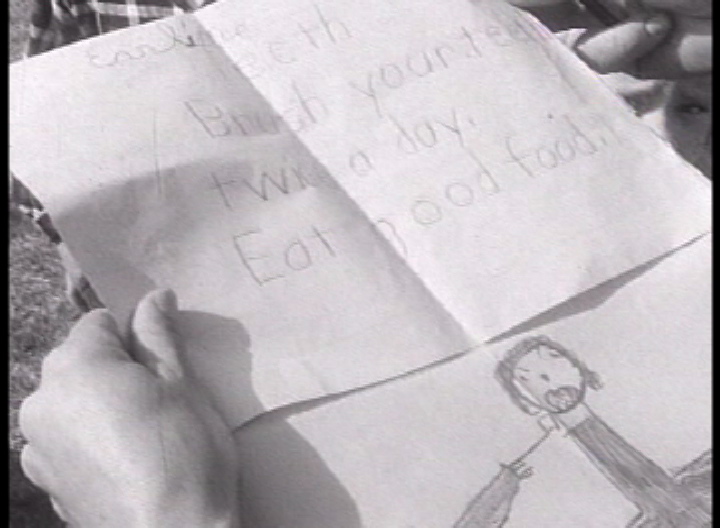
A little girl named Earline encounters a man on her way home from school who tries to lure her into his car. Obviously, she’s watched plenty of Sid Davis films at school, because she immediately turns him down and writes down the license number of the car. Then she takes this information home to her mother, who, amazingly, blows it off. So the next day, the man manages to successfully pick up a classmate of hers who must have been home sick during the showing of The Dangerous Stranger. When her mother calls the school to inform them that her daughter didn’t make it home, the principal conducts a search of the playground, asking every kid there whether or not they saw the missing girl. None of them did, except for one plucky little boy who saw the girl get into the man’s car. At this point, the police are called, and they go through an excruciatingly long process of calling in detectives (including a female detective with cat’s eye glasses that have to be seen to be believed), questioning all the children again, sending out an APB, and patrolling the streets at about 15 miles an hour. Fortunately, the child molester turns out to be too neurotic to work quickly, so by the time a police officer spots his car and picks him up, the girl is unharmed. (In real life, she would have been raped, dead, and buried in a field somewhere by that time, hence the Amber Alert.) All this is told through narration, with overly-dramatic music on the soundtrack. Then the movie focuses on prevention, which amounts to stating that this never happens to nice families who have regular bedtimes for the children. The narrator tells us that Earline’s mom feels guilty for ignoring her child’s report of the strange man, but this is said over footage of her blithely reading a magazine, looking like she hasn’t a care in the world. In this film, the only smart people appear to be the kids. Watch for the cheesy title cards made with plastic letters and the scary drawing Earline made to go with her theme on dental care.

Ratings: Camp/Humor Value: ****. Weirdness: ****. Historical Interest: ****. Overall Rating: ****.

Better Reading

Better Reading . Teenager Harold Wilson has a problem—he can’t read for (expletive deleted). So he has to spend all his free time studying ...